Showing posts with label Maltese. Show all posts

Friday, 24 January 2014

Maltese Breakfast with a Difference

Orange marmalade spread on bread
Extra Virgin olive oil and Olives

Olive oil and mint on crispy local bread


For more info about eco and agri tours, farm visits, and tasting sessions drop me a line on jeanette@merill.com.mt or visit our website www.merill.com.mt.


Saturday, 3 November 2012

Merill Eco Tours hosts a dynamic team of Food and Beverage experts

Hello Merill fans,

October 2012 has now gone by, and it still feels like summer in Malta. Today has been an exceptionally clear and sunny day, perfect to enjoy the rural parts of the Maltese islands. Having been blessed with fantastic weather throughout September and October, we have enjoyed hosting more groups on our various farm venues around Malta. 

Amongst the groups we hosted in October, we had the pleasure of hosting the Food and Beverage managers and supervisors at Intercontinental Malta. This dynamic team of young people are experts in hotel and restaurant management. Now I'm looking even more forward to visit the various restaurants managed by Intercontinental Malta, such as Eastern Breeze, Paranga and Harruba, to taste the exquisite food prepared by this team :) 

We would like to show gratitude to Mr. Bradley Dingli, the Director of Food and Beverage, who entrusted us to organise a day out for his colleagues, and who took the time to write the 5 star review on our official Trip Advisor page seen below.


“FANTASTIC EXPERIENCE WITH MERILL ECO PRIVATE TOURS FOR OUR COMPANY OUTING


Smiling - Photo by Ms. Angie Borda
"We come from a very stressfull and demanding routine on a daily basis at work. Two groups of 20 persons each decided to organise 2 seperate but identical events with this company and Jeanette (together with her husband Chris) assisted us from the very start. We made it very clear that we want to enjoy a full day activity within peaceful surroundings, whereby a group of working colleagues would spend a full day away from the normal routine at work. What Jeanette organised was spot on....they took us to Bingemma Olive Grove to start off with. As a local i have been to this area, however this Olive Grove boasts one of the best views in Malta, apart from a surrounding area that is astounding to spend some hours at with friends. The group tasted some good olive oil, marmalade and consumed some local pastizzi accompanied by coffee and tea (which tastes delicious in this environment). The friendliness and hospitality experience by Charles and his wife at the Olive Grove is an experience not to be missed. Jeannette and Chris enhance the experience by thier knowledge on agriculture, explaining the different types of olive trees and some very interesting information on how the olive oil is pressed; how many olives you need to press a litre of olive oil etc etc. It did rain a bit when we were there with the 2nd group however no one hesitated as there was plenty of shelter for a group of 20.


Intercontinental F&B team - Group 1 - Photo by Ms. Angie Borda

After an hour and a half at the Olive Grove we proceeded to the limits of Rabat and visited a vineyard. Again Jeanette explained a lot about the type of grapes grown and the variety of wines produced. Being locals and having a group of people who's job is in Food & Beverage, she didn't need to elaborate a lot but it was very interersting. The lady at the vineyard prepared a selection of wines (red, white and rose) for us all to try, followed by a nice spread of a typical local table filled with Hobz biz-zejt (traditional Maltese Bread with tomato spread and olive oil), Goat's Cheese, Capers, Pickled Onions, Bigilla (a bean dip), Bruschetta Mix, Olives, and Sundried Tomatoes, which proved to be a very enjoyable meal in the afternoon. Views from the vineyard are exceptional, especially from the roof terrace. We spend at least 2 hours at the vineyard enjoying the wine, food and company. Jeanette and Chris finished it off with some nice local sweets and hot beverages before saying their good byes. 

This was the first time with Merill Eco Private Tours however it will not be the last. Jeannette and Chris you know have 40 ambassadors, promoting your services as you truly offered us a fantastic programme for our company outing. Above all the best thing is that Merill keep the local traditions and local produce alive and highly exposed to the selected few. thanks one again and hope to see you all soon."

Ms. Angie Borda who is part of the Intercontinental Malta team, has also left us a review and a photo, and for this we would like to say thank you.

We hope to host this team again very soon and in the mean time we wish them all the best for the coming hectic Christmas season!

Cheers

Jeanette


Visited October 2012


Thursday, 20 September 2012

Cosa c'è a Malta?


Se vi interessa Malta come destinazione per vacanza o lavoro, avrete di sicuro intenzione di visitare la Valletta u Mdina. Queste due città sono una chicca di storia e cultura, piene di chiese, monumenti e piazze. 

Non molti italiani sanno che a Malta c'e tanto altro da vedere e visitare, come ad esempio i villaggi e la costa, molto interessanti. 

Il paesaggio rurale, offre una scelta di attivita agro-turistiche e sportive. Noi di Merill Eco Tours, siamo specializzati nell'organizzare esperienze agri ed eco turistiche, per piccoli gruppi (10 - 40 persone).


Lasciatevi immergere nelle zone rurali di Malta, tra fitti bosci e muretti. Guidati da una guida esperta, vi porteremo in posti che non si vedono sulle cartoline di Malta, perchè  solo in pochi 
conoscono i tesori nascosti di Malta. 

Le nostre gite sono un'assaggio di quello che ha da offrire la terra di Malta. Potrete gustare delle delizie popolari prodotte dagli stessi maltesi e godere di panorami mozzafiato.

I villaggi più belli sono quelli in cui gli agricoltori coltivano la terra ancora con pratiche tradizionali. Ci sono venti agricoltori e artigiani nel nostro network. Con loro organizziamo esperienze di degustazione, e attività di recreazione e relax. I vigneti, oliveti, allevamenti di capre e bovini, sono luoghi eccellenti per vedere il cuore di Malta e assaggiare prodotti tipici maltesi. La nostra cucina è un cocktail di sapori mediterranei e di sicuro troverete la nostra ospitalità molto gradevole. 

Se in caso volete contattarci, lo potete fare tramite il nostro sito web o dalla pagine su Facebook. 

Vi aspettiamo questo autunno!

Cari saluti

Jeanette Borg
Merill Eco Tours

Saturday, 5 May 2012

Good Vines and Wines in Malta

Hello Merill fans,

Hello!
Hope you're all doing great! Just a short update about our activities in Malta. The weather is perfect...sunny and warm in the morning and cool in the evening. Vines have now greened the valleys and hills of the Maltese countryside. We're keeping our farmers busy with agri experiences right now. Visiting Valletta and Mdina is a must if you come to Malta, and so are our experiences which take place just a few kilometers away from these well known cultural sites. In just a a matter of hours we accompany our guests at the best locations of our island. 

Our network of hard-working farmers, enables us to choose the perfect venue, be it a secluded olive grove or a vineyard with stunning views in the heart of a rural area. Here are some photos for all of you to enjoy!

Should you need more info about our alternative experiences, visit our website and send us an email on info@merillecotours.com.


Saħħa!


Jeanette
Vines have now turned the landscape in Malta green

A boy's toy!
One last strawberry... et voila!

Ready!


Wie Merill Lokale Produkte, arbeiten wir mit den lokalen Bauern, um Erfahrungen zu Einheimischen und Touristen bieten, sowie vertreibt eine breite Palette von Produkten während der Besuche auf Bauernhöfen. Unser Sortiment umfasst Olivenöl, Wein, getrockneten Tomaten, Meersalz, Zwiebeln Gewürzgurken und Honig.


Sunday, 29 January 2012

The Maltese Vine and Wine Experience

If you are interested in everything that has to do with wine, then this is your ideal experience in Malta. This is not like any other wine tasting experience. At Merill Eco Tours we work closely with real farmers who are dedicated to produce high quality food and beverage products for consumers. This is why we included a visit at a vinyard where vines are meticulously taken care of, to produce excellent grapes. During this experience, you will be able to learn about the cultivation of vines, such as pruning, grafting and sustainable water and fertiliser use. Then, you will have the opportunity to taste a variety of local wines produced by a leading Wine Producer Organisation. Other delicacies such as genuine cheeselets will enhance this experience. The fresh air and countryside views will make this experience a relaxing one to all those wine lovers who want to discover the real Malta.

To view other related experiences such as olive oil tasting, click here! For more information send us an email on info@merillecotours.com 


Saturday, 31 December 2011

Happy New Year from Merill Eco Tours!

This will be our last blog article for 2011! Oh what a year!

Merill Eco Tours will soon be a year old and we're so proud of the way it's been growing so far.

It's nice to look back at what we have been up to this year. We started off the venture and the year with the Press Launch which took place on the 12th of January. It was raining cats and dogs before and during the presentation, but still a nice crowd of around 50 attended the launch. Hon. Dr Mario De Marco officially inaugurated Merill Eco Tours as the first licensed ecotourism venture operating in the Maltese Islands.
(Click here to view the clips of the TV coverage; TVM and NET TV.)

Following the launch we immediately started cooperating with various tour operators and local DMCs to fine-tune our eco and agri tours, which are offered both for tourists and locals. The exclusive locations, together with the delicious products enjoyed during the tours, have been an asset to put forward a positive and attractive image of Malta as a rural tourism destination.

Our farmers have been kept very busy producing local products and other delicacies for our guests. Along the year we also branded a range of traditional processed products which were brought direct from the farmers and promoted at a number of different occasions and venues. In September we were also pleased to discover that our honey was featured in an official EU publication, amongst many other food products from all around Europe.

Traditional food products from all EU Countries

Sea Salt mini jars as souvenirs

To raise awareness about the richness of the Maltese rural areas, we are now producing short video clips, which we named '90 eco seconds', capturing the very best scenes and activities in local villages. Our first clip features Mgarr, which is truly an agricultural hub of the Maltese Islands.


We sincerely wish a prosperous new year to all our fans all around the world, especially to our dear Maltese expats who follow us regularly. Our special thanks go to our families and friends as well as all our business partners who have been part of this amazing journey.

Lots of eco wishes from Jeanette and Christian!

Sunday, 18 December 2011

It will soon be Christmas!


Hey Merill fans,

hope you're all doing fine! We thought of featuring the red breasted robin as it will soon be Christmas. It is a lovely time to be in the countryside here in Malta. So many winter birds singing and the weather is still nice and warm. Christmas holiday makers are keeping us busy and so are the eco hampers. 

the best seller for Christmas 2011
Though the Maltese people are very price conscious this season, we still had many customers asking for tailor made hampers with their favourite local ingredients. For sweet tooth clients, we included locally made mince pies and treacle tarts, perfect while enjoying a nice cup of tea or coffee. We're proud of these two items in our eco hampers as they are traditionally made with lots of passion and dedication by the staff at Maypole Bakeries. I was personally amazed about the genuineness of these items as they taste just like home made.

This week, I had the opportunity to visit the brand new Maypole Bakery in Tal-Handaq, where dozens of bakers and pastry chefs are busy preparing yummy cakes and pies. Was also pleased to get to know that hundreds of Cassatella tarts are being prepared with local ricotta cheese. The secret ratio between ricotta, sugar, chocolate chips and other ingredients make the Cassatella superb in taste and texture.

Guess I will have to follow a strict diet soon after Christmas, considering all the bountiful items I am obliged to taste on a regular basis...this make me love my job :)

We will keep you posted with more eco news and look forward to have a merry merill Christmas.

"Like" our Facebook fan page or visit our website www.merillecotours.com

Feel free to drop by any comments on info@merillecotours.com - we love to hear from our fans.

Saturday, 10 September 2011

The Maltese Goat Breed


This breed is known throughout the Mediterranean and it was common for farmers from other countries such as Sardegna, to come and buy goats from Maltese farmers. The Maltese goat is typically black and is renowned for its high yield of milk. Unfortunately, at the moment, there are no 100% pure-bred goats in Malta. However one can still find them in Sardegna in Italy. The drastic decline of this breed from the Maltese Islands was the discovery of Brucellosis (Brucella melitensis) in the goat’s milk by Sir Temi Zammit. A misconception was initiated in that only goats’ milk contained the disease this urging Maltese farmers to look for other milk producing farm animals.  Infact the government of that time supported this idea by having a programme against goat rearing and proposed a scheme that gave a cow (Holstein Friesian) in exchange for five goats (1).

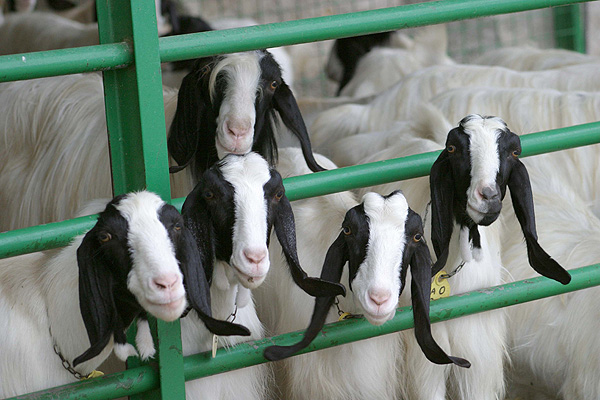
Maltese Goats - Photo by Salvatore Pipia
The Maltese goat has a white body with long hair, black head and large dropping ears and originated from the Middle East. This breed does not have horns. It is usually raised in small flocks of about 40 - 60 heads. Kidding occurs during the whole year, with a concentration during the months of November and February. Milk production is about 350L with a high fat and protein content, 3.8% and 3.3% respectively. Prolificity is of 180% as is considered as high. (Rubino, R.; 1993) (2).

Due to the lack of pasture land, an open yard system is commonly used for housing goats in Malta (2). Shelter needs to be provided in case of bad weather. However in countries having a higher availability of pastureland, the extensive production of goats is possible. Housing goats in the dark for several hours each day in the spring and summer months will result in an earlier estrus. Conversely, artificial lighting in the goat barn may delay estrus in autumn (6).

In Malta up to the late forties, the herdsman would take his flock round the village streets where he would milk the goat at one’s doorstep. (3) Nowadays the small portable milking machines are preferred. Milking parlors are not commonly used as the number of goats in a flock is usually small (2).

Goat milk has played an important role in human nutrition for a long time because of its nutritional and dietetic characteristics (Morand-Fehr et al., 2000). The Maltese goat as an indigenous breed, supplied households with milk and before the introduction of the Holstein Fresians, goat milk was the only source of milk. 

The importance of goat milk in infant diets is growing probably because goat milk in some cases is less allergenic than cow milk. Maltese Goat milk has often been processed into cheese. Goat cheese is of a hard-texture, made with full-cream raw milk. Curdling is carried out in woody tubs at 35 °C for 45 min by adding lamb’s rennet. The ripening ranges from a few days to some months (Rubino, 1996). Its sensorial profile is particularly appreciated among cheese tasters. An interesting study elaborated the effect of lactation on the flavour of cheese made with raw milk of Maltese goats bred in Sicily (Italy). The goat cheese flavour was analyzed for the first time by Solid Phase Microextraction (SPME) coupled with Gas chromatography/Mass Spectrometry (GC/MS) (5).

In my opinion several actions can be taken towards the improvement of the situation of this breed. The loss of such a valuable breed can mean loss of agricultural biodiversity in the island of origin, that is Malta, but also in the Mediterranean context.


Reintroduction of the breed into Malta

The modern goats breeds are said to be reproducing nicely. Although goats have done considerable damage to the local flora in the past, they are more suitable for Malta then cows which are adapted to graze on pastures, rather than the rocky hills that are more typical of the Maltese islands (1)

So far there are no plants to reintroduce the Maltese goats back to Malta. The use of goats has decreased in these years and the only goat breed one can find in Malts is mainly the Syrian, which are mainly red in colour and which used to be imported from Syria and then exported to North Africa. Although no pure-breed Maltese goats remain in Malta, one cannot exclude that some of the local goats may be closely related to the pure Maltese breed. It is a pity that having a breed with strong cultural roots is totally absent from its place of origin. The Maltese male goat is depicted on stones from the Tarxien prehistoric temple (3).

There are various initiatives which the local government can take so as to reintroduce this breed. Being a member of the European Union, we can benefit from the various funds to achieve this aim. LEADER projects and LIFE projects have aided such purposes in several countries in the past. Nonetheless such initiatives can be taken to Malta’s advantage and conserve local biodiversity (8).


Kindly acknowledge Jeanette Borg when using any part of the text in this article.
(Reference: Borg J. 2008, The Maltese goat breed)


References:

  1. Galea De Giovanni Martin; Agro-Biodiversity Campaign; Paper on Maltese Agro-Biodiversity; Friends of the Earth

  1. Blundel R.; 1994; Reintroduction of the local breeds of sheep and goats in Malta; CIHEAM; Options Mediterraneennes; Department of Agriculture, Government Farm for Research and Development; Ghammieri; Malta
  2. Busuttil Salvino; Agriculture in Malta: A Historical Note; Options Mediterraneennes; United Nations Environment Programme, Co-ordinating Unit for the Mediterranean Action Plan, Athens, Greece

  1. Gigli Isalbel, Sardina Maria T, Budelli Elena, Finocchiao Raffaella; Genetic and Protein Polymorphism at CSN1S1 Locus in Two Goat Breeds; Universita degli Studi di Palermo, Dipartimento S.En.Fi.Mi.Zo., Palermo, Italia.

  1. B. Chiofalo, A. Zumbo, R. Costa, L. Liotta, L. Mondello, P. Dugo and V. Chiofalo; Characterization of Maltese goat milk cheese flavour using SPME-GC/MS; South African Journal of Animal Science 2004, 34 (Supplement 1); South African Society for Animal Science Peer-reviewed paper: 8th International Conference on Goats

  1. Camilleri K; 2001; The economic aspects of breeding sheep and goats in Malta; Dissertation Diploma in Agricultural Sciences; University of Malta

  1. Uysal-Pala C., Y Karagul-Yuceer, Pala A. Savas T.; Sensory Properties of Drinkable yogurt made from milk of different goat breeds; Journal of sensory studies. Malden, USA: Blackwell   Publishing Inc 2006 Oct., v. 21, no. 5, p. 520-533

  1. Horst Korn, Rainer Schliep, Cordula Epple; 2005; Opportunities of EU Agricultural Policy Instruments for Biodiversity Conservation and Integrated Rural Development in Protected Areas of the New Member States; Report of the workshop convened by the German Federal Agency for Nature Conservation at the International Academy for Nature Conservation; http://www.bfn.de/fileadmin/MDB/documents/skript153.pdf

  1. G.M. Vacca, L. Chianese, A. Ghibellini, V. Carcangiu, R. Mauriello, P.P. Bini; αS1-casein genetic variants in Sarda goat breed; Dipartimento di Biologia Animale; Università di Sassari

  1. Gabina D.; Management of European Sheep and Goat Genetic Resources; Options Mediterraneennes; Mediterranean Agronomic Institute of Zaragoza; CIHEAM; Spain


Other useful links;

Heritability Estimates of Lactation Traits in Maltese Goats

Reintroduction of Maltese Sheep and Goats

Brucellosis and Maltese Goats in the Mediterranean

Characterisation of Maltese Goat milk cheese flavour

The Black Maltese Poultry Breed

Photo by Jeanette Borg


In-Situ conservation of the Black Maltese and performance evaluation under a small-scale intensive system - J.G Mallia

Sunday, 28 August 2011

The Kingfisher in Malta


The Kingfisher at rest
This morning has been particularly exciting to one of our expert birders, Chris Cachia Zammit. He managed to capture this beautiful bird while resting. He told us that the Kingfisher is one of the few colourful birds that come to Malta. In spite it's colourful plumage, the bird is quite difficult to spot, but from time you get a glimpse of the bird flying. If your lucky, you might spot the Kingfisher fishing or resting on a pole. These birds migrate to Malta in August and some of them spend the winter time in the Maltese Islands. The scientific name for this species is Alcedo atthis and its Maltese name is Ghasfur ta’ San Martin.


For more information about bird-watching tours, visit our website www.merillecotours.com or send us an email on info@merillecotours.com.

Tuesday, 19 July 2011

Migration of the Marsh Harrier over Malta

Marsh Harrier - Natalino Fenech

The Marsh Harrier is the most numerous bird of prey during the autumn migration through the Maltese Islands. They start to arrive at around mid-August and continue making their way till mid-October, sometimes even late October.

The peak is normally reached during September. This medium sized bird of prey normally hunts small mammals, insects and also other birds even during migration.


Write up by Christopher Cachia Zammit and Michael Sammut

Saturday, 7 May 2011

The Taming of the Shrew...The Etruscan Shrew of Malta and Gozo

Scientific name: Suncus etruscus
English: Etruscan shrew
Maltese: Buggedum zghir or Gurdien Geddumu twil 


Photo and information by Mr. Arnold Sciberras


Information:  This species is the smallest known mammal by mass, weighing only about 1.8 grams on average. Because of their high ratio of surface area to body volume, the Etruscan shrew have an extremely fast metabolism and have to eat 1.5–2 times their body weight in food per day. They feed up to 25 times per day, mostly on various invertebrates (insects, their larvae, earthworms, etc.) as well as small vertebrates (young frogs, lizards and rodents), and can hunt prey of nearly the same body size as themselves. They prefer species with a soft and thin exoskeleton and for this reason avoid ants when given a choice. They kill large prey by a bite to the head and eat them immediately, whereas they take small insects back to their nest. When hunting, the Etruscan shrews mostly rely on their sense of touch rather than vision and may even run into their food at night. The Etruscan shrew might play important role in controlling the insect population. Unfortunately although protected by law, this is the fate of many as when they enter houses to feed on pests they are mistaken for mice instead of being welcomed. In Gozo an endemic species occurs.

Etruscan Shrew [photo by Arnold Sciberras]


Thursday, 5 May 2011

With a Pinch of Salt

Salt Pans in Malta
The harvesting of salt in Malta dates back to centuries ago. Being an island in the centre of the Mediterranean, shipments used to stop for replenishment thus taking with them essential items such as salt. Salt pans (in Maltese: 'Salini') are found in various areas around Malta and Gozo, most of which are unfortunately inactive. It is a tough job to harvest salt and the skill is being lost in time.


I feel there is still some hope left for this tradition. At Merill Eco Tours we created a tour that focuses on traditions such as salt production. During such a tour, salt pans are visited and a demonstration is given to our guests. Hands-on salt harvesting experiences can be organised upon request between May and September. Crispy Hobz biz-Zejt (local bread and olive oil) is served during the excursion as a snack in summer... obviously with a pinch of salt!

Here is a very good article about Salt Production in the Maltese Islands by Mr. Martin Morana - History of Salt Production in the Maltese Islands

Friday, 15 April 2011

Spectacular Air Show (Spring Migration 2011)

Kestrel - Photo taken by Chris Cachia Zammit
Just spent a great time bird watching. We spotted some lovely birds of prey. During the span of an hour lots of Marsh/Montagu's Harriers and Kestrels flew over our heads. Most of them were finding a place where to roost during the night. We met some keen birders carrying out observations and taking photos. We hope that all the birds we saw will make it to Sicily and none of them will be victims of poachers during the night.


Bird watching is an activity to be recommended as part of ecotourism in the Maltese Islands. Hundreds of bird species reside and migrate across Malta. Migration seasons are Autumn and Spring. 

Leave only footprints...take only photos :)

Subscribe to mailing list for free. Members are eligible for some great offers.